
The One Thing in Every Room That's Silently Hurting Your Dog (And You Don't Even Know It)
Your dog notices everything you burn. A nose 100,000 times more sensitive than yours picks up every particle — which is exactly why we took the chemistry of our candles seriously from day one.
At The Sabal Collection, we've always believed that luxury should never come at a cost to the ones you love — and that includes your four-legged family members. Since we developed our original formula during the pandemic, we made a deliberate choice: every ingredient would be evaluated not just for scent and performance, but for what it releases into the air you and your pets share.
The candle industry has a transparency problem. Most brands are not required to disclose every chemical hiding inside a "fragrance" blend. Meanwhile, the science is clear about what those hidden ingredients can do — especially to animals.
What's Actually in Most Candles?
The majority of commercially sold candles are made from paraffin wax — a petroleum byproduct. When burned, paraffin releases volatile organic compounds (VOCs) and carcinogenic soot. For dogs, whose respiratory systems are smaller and whose sense of smell is dramatically more powerful than ours, what might be a minor irritant to a human can become a real problem.
Then there are the fragrance blends. By law, the full chemical makeup of a "fragrance" can be hidden under that single word on a label — even if phthalates make up 20% or more of the product. This is where many candles carry their greatest risk.
The Chemicals We Actively Avoid
Synthetic plasticizers used to extend scent longevity. Research suggests chronic exposure may contribute to cancer, hormone disruption, and reproductive issues in pets. Metabolized less efficiently by dogs than by humans, increasing risk of bioaccumulation.
Releases benzene, toluene, acetaldehyde, formaldehyde, and acrolein when burned — all known carcinogens or respiratory irritants. The soot alone can exacerbate asthma in both pets and humans.
A crude oil-derived compound found in some candle fragrances. Linked to lung and eye damage in dogs. Also used as an insecticide — something that should never be diffusing through your living room.
Although banned in the U.S. since 2003, some imported candles still contain metal-core wicks that release lead particles when burned. Lead is severely toxic to dogs, even in small amounts.
Many candle colorants release additional VOCs when heated. We keep our candles dye-free to eliminate this variable entirely from the burn equation.
Preservative chemicals linked to endocrine disruption. Our formula is entirely paraben-free — for your health and your pet's.
"Candles made from paraffin wax, that use a lead wick, or release synthetic oil and fragrances can be toxic. Fragrances and oils can aggravate existing respiratory illnesses like asthma in pets due to harmful toxins such as naphthalene or phthalates."
GoodRx's veterinary health team notes that research suggests phthalate exposure can cause cancer in pets, and other studies indicate they may cause issues with sexual function, fertility, and development. The troubling part: these chemicals are legally allowed to be hidden under the word "fragrance" on product labels.
Veterinary sources and pet health researchers also flag several fragrance-derived essential oils as problematic for dogs, particularly when used in high concentration: tea tree, wintergreen, pennyroyal, cinnamon, clove, eucalyptus, and pine. We don't use these as primary scent drivers in our formula.
A Word About Plug-In Air Fresheners

Candles often get the scrutiny, but plug-in air fresheners — the Glade plug-ins and similar devices found in millions of homes — may actually be more dangerous for dogs. And unlike a candle you light occasionally, plug-ins run continuously, delivering a steady, all-day stream of synthetic chemicals directly into the air your pet breathes.
Veterinarians have documented a troubling range of reactions in dogs exposed to plug-in air fresheners. According to PetMD, essential oils dispersed through plug-in devices are associated not just with gastrointestinal upset, but with neurological problems — including agitation, weakness, unsteadiness, and tremors. In more severe cases, veterinary sources report that plug-in diffusers and air fresheners have been linked to seizures and, in extreme situations, death.
"Essential oil diffusers or plug-ins can be toxic to your pet and even cause illnesses such as seizures or, in extreme cases, can even result in your dog or cat dying." — Courtney's Pet Care Blog, citing veterinary sources
Part of what makes plug-ins uniquely risky is their position in the home. These devices are typically installed at outlet height — which is exactly dog height. A dog resting near a plug-in is breathing concentrated VOCs at close range for hours. Ethanol, one of the common carriers in plug-in formulas, is toxic to dogs in relatively small amounts, and ethanol poisoning can be fatal if untreated.
A study published in the Environmental Impact Assessment Review tested the top-selling air fresheners on the market and found 133 different VOCs emitted across 25 products, with an average of 17 VOCs per product. Of those 133 compounds, 24 are classified as toxic or hazardous under U.S. federal law — and every single product tested emitted at least one. Products labeled "green" or "natural" showed no significant difference in toxic compound emissions.
Beyond inhalation, plug-ins carry an additional exposure risk that candles don't: the oils they disperse can settle as microdroplets on your dog's fur. When your dog grooms themselves — which dogs do constantly — they ingest those residues directly. 24PetWatch specifically warns against this secondary ingestion pathway, noting it can lead to toxic buildup over time.
We're not here to tell you how to run your home. But if you're reading this because you care about what goes into the air your dog breathes, plug-ins deserve the same scrutiny — if not more — than the candles you light.
What We Chose Instead
Our formula wasn't designed around what's cheapest or most common — it was designed around what's cleanest. Here's what that looks like in practice:
- A premium coconut wax blend — not paraffin — for a cleaner, lower-emission burn
- Natural, lead-free cotton wicks — no metal cores, no hidden toxins
- Fragrance blends that are phthalate-free, paraben-free, and carcinogen-free
- No synthetic dyes — ever
- Cruelty-free sourcing — we refuse vendors who test on animals
- Full commitment to vegan-friendly, non-toxic ingredients throughout

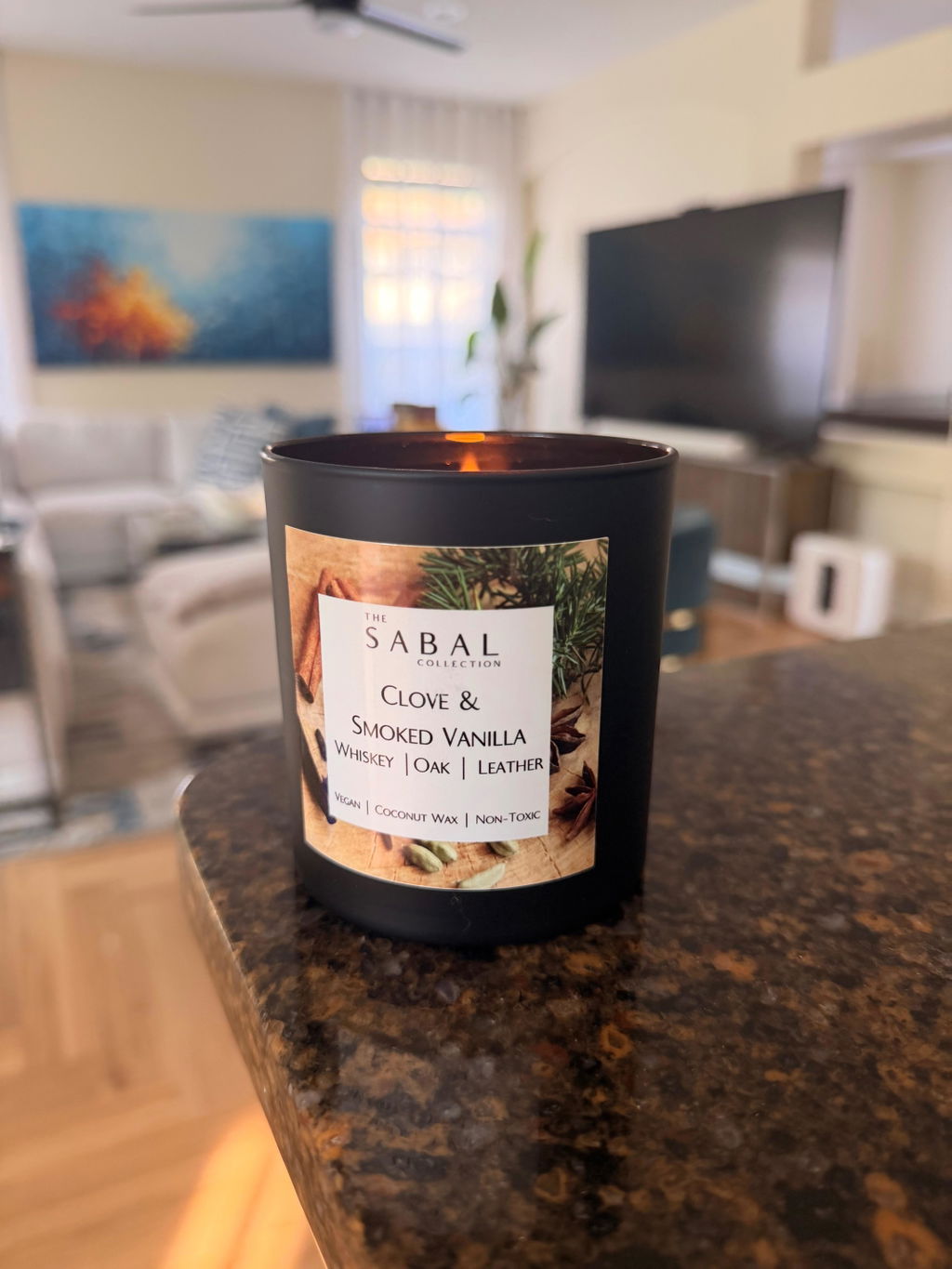
Every scent in The Sabal Collection — from Winter Woods to Clove & Smoked Vanilla to our Summer 2025 offerings — is developed with this framework in mind. We work with a Black woman-owned manufacturer in California who shares our commitment to clean, transparent ingredient standards.
Burn Smart: Tips for Pet Parents

Even with the cleanest candle, thoughtful burning habits make a real difference. A dog's sense of smell is between 10,000 and 100,000 times more powerful than a human's — which means strong concentrations of any fragrance can be overwhelming, regardless of how safe the ingredients are.
Burn in well-ventilated rooms. Never confine a pet in a small space with a burning candle. Keep lit candles well out of reach of curious paws. And pay attention to behavioral cues — if your dog is leaving the room, that's a signal worth honoring.
We've done the work to eliminate the chemicals most commonly linked to adverse reactions in pets. Our candles are free of phthalates, parabens, carcinogens, lead, paraffin, and synthetic dyes — the primary known offenders when it comes to pet sensitivities.
However, just as humans can have individual allergies to perfectly natural substances, dogs can too. Every animal is different. We cannot guarantee that any candle — ours included — will be completely reaction-free for every pet. If your dog has known sensitivities or respiratory conditions, we recommend consulting your veterinarian before introducing any scented product into your home.
What we can say is this: we have deliberately removed the ingredients science has identified as most harmful. If you ever notice sneezing, coughing, watery eyes, or restlessness after lighting a candle, extinguish it and give your pet fresh air.
Luxury and responsibility shouldn't be in tension. At The Sabal Collection, they're the same thing. We built our candles to be something you can genuinely feel good about — for your home, your health, and the animals that share your space.
That's been true since our first pour. It will be true in every collection to come.
Sources & Further Reading
- BC SPCA — Fall Toxins for Your Pet to Avoid
- GoodRx — Scented Candles: Are They Bad For Dogs?
- Pet Butler — Are Candles, Essential Oils, and Air Fresheners Safe For Pets?
- 4-Legger — What Science Says About Scented Candles & Pets
- Woofs & Wax — Why Pet-Friendly Candles Matter
- Dogish — Are Scented Candles Safe for Your Dog?
- Tomlinson's Feed — Are Candles Safe for Your Pet?
- PetMD — Are Air Fresheners Safe for Pets?
- PetHelpful — Could Your Air Freshener Be Making Your Dog Sick?
- WNC Pet Care — The Silent Threat: How Air Fresheners & Plug-Ins Can Harm Your Pets
- Courtney's Pet Care — How Dangerous Are Scented Oil Diffusers For Pets
- The Animal Keeper — How Air-Scenting Products Can Harm Your Pet


Leave a comment